Subscribe here to receive resources, webinars and support group listings to your inbox each month.
New resource: Side Questing to Your Destination
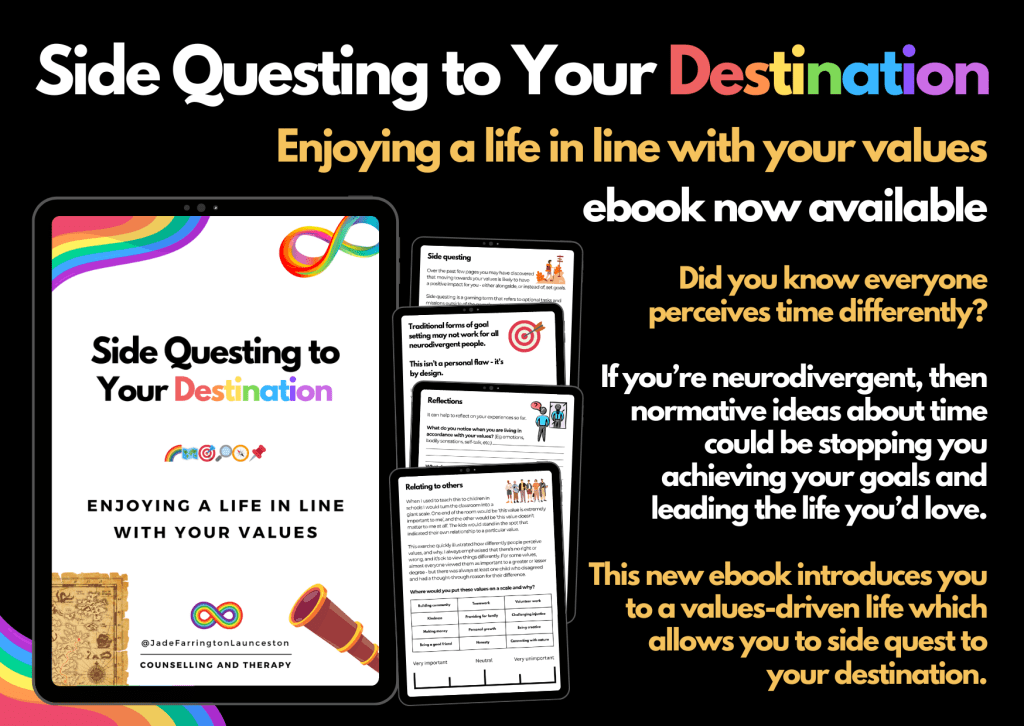
It’s a pretty well-kept secret that everyone experiences time differently. Chronos – or clock time – dominates, but it may not align with your way of being and experiencing the world.
This new resources takes you on a journey through obliquity, and how aiming directly for your goals can stop you achieving them. You’ll learn how a values-driven life can be far more effective and fulfilling, and how your interpretation of time interacts with this to inform your success – or scupper your attempts to achieve.
‘Side Questing to Your Destination: Enjoying a Life in Line with Your Values’ is included with any paid Substack subscription. It costs £5 per month (or the equivalent in your local currency), with no tie-in.
To receive new resources and access to my full back catalogue of downloads and articles you can upgrade to a paid Substack subscription.
If subscriptions aren’t for you then many of my ebooks are available individually here.
Children
Chris Coghlan MP reflects on how UK local authorities’ “lawbreaking, gaslighting and lying” are wrecking thousands of children’s lives
Dr Aimee Grant has published ‘The Autism-Friendly Guide to Pregnancy, Birth and the Fourth Trimester’
Gráinne Warren discusses building authentic connections instead of ‘training’ social skills
Helen Edgar explains co-tropical attention as a way of meeting a child inside their flow instead of pulling them out
Mick Olds shares ways for children to engage in their interests beyond screens
Michael Charles says the systemic wrongdoing against UK children is endemic
Alice Running explains how the SEND system stole her children’s childhoods
Laura Hellfeld explores how labelling children can cover up hidden health needs
Bridgette Hamstead on how neurodivergence made her a better parent
Elspeth Hetrick explains why meltdowns are incompatible with ‘teaching moments’
Alice Running offers ten take-aways from ten years of navigating systems of autism support
Mandy Cook looks at why it’s important to tell children if they’re neurodivergent
Marion McLaughlin reminds that there’s no crystal ball to see what an Autistic child’s future will look like
Libby Hill explains why local authorities can’t refuse to accept reports from private practitioners
‘Minding My Sensitive Self: A Guide to Reclaiming Our Sensitive Identities’ by Evaleen Whelton is now available for pre-order
Ava shares her experience of being a Young Leader with GROVE
Meghan Ashburn offers one piece of advice to parents of newly identified Autistic toddlers
Chris Wenger explains why children may laugh when in fight or flight
Navigating inter-neurotype sibling relationships
Rebecca Engle explores the delusion of ‘play-based ABA’
PDA
Amanda Diekman looks at how PDA kids meet autism diagnostic criteria
Natalie Froud explores different PDA presentations and how they shift over time
H Arlo-Harris shares how they realised they were PDA
Education
Barriers to Education has launched with information and resources for families and professionals
Dr Joanne Riordan shares ten things everyone should know about supporting dyslexic learners
Pam Laricchia looks at other options when school isn’t working
Nicola Reekie shares her family’s experience of the trauma that can be caused by the education system
Chris Wenger challenges the use of supports as rewards
Teo Byrne looks at England’s new phonics targets
Teo Byrne on new Year 8 reading tests
Natasha Leahy on the forgotten children who quietly slip out of classroom
Evaleen Whelton shares an example of how Autistic children are harmed by school support plans
Danielle Gary looks at designing schools with everyone in mind
Rebecca Engle explores why Positive Behavioral Interventions and Supports harm kids
Helen Buzdugan on what happens when people are told to be patient and trust in the system
Emma The Autistic SENCo reflects on statistics showing that 1 in 12 UK secondary school students are put in isolation every week
Kristy Forbes asks if teens are being taught in sex education that their children may be disabled
Kelly Mahler looks at what happens when curiosity is prioritised over compliance
Alice Running critiques the idea that parents seek diagnoses for exam advantages
Helen Buzdugan challenges the idea that all schools and local authorities are doing their best under very difficult circumstances
Emma The Autistic SENCo on reasonable adjustments at school
Mandy Cook explains gestalt language processing
Jennifer looks at whether phonics can help gestalt language processors
Jodie Clarke and Claire Neaves discuss neurodivergence and education
Sandra Coral on seeing ADHD children beyond gender expectations
Alice McSweeney shares her experience of socialising as a home educating family
Jess Garner and Kieran Rose discuss the current situation in schools; what can be improved right now; and reimagining education
Apraxia and Non-speakers
Nicole Prenoveau and Tiffany Joseph discuss communication and education rights for Autistic non-speakers
Danny Whitty has released an on-demand course, ‘Goals for a New Life: Setting & Managing Goals for Spellers’
‘A Day with No Words’ by Tiffany Hammond will be published on November 4th
Tiffany Joseph explains why using a letterboard can be necessary to communicate
Dr Marina Weiler on non-speaking autism, The Telepathy Tapes, and who gets to be heard
Tiffany Joseph explains how Autistics with communication privilege cause harm to the most marginalised in the community
Dmitry Ciocea on advocating for the communication of non-speaking children at school
Tbonez explains how he raps with a computer due to cerebral palsy
Tiffany Hammond looks at the invalidation of communication from non-speakers
Tiffany Hammond on Spellers, “Profound Autism,” and the fight to keep options open
Beth Moulam outlines what happened as a result of their parents presuming competence
Niko Boskovic explains why accommodated living makes sense for him
Bri Guerra shares memories of the dehumanising ways in which people treated her before she could type
Libby Hill on the importance of listening to all forms of communication
Kristy Forbes shares her fears for the rights of her non-speaking teen
Tiffany Hammond on doing the best she could for her son with the information she had at the time
Nicole Gottesmann expresses her regret for not having her son Spelling sooner
Neurodiversity Paradigm Exploration
David Gray-Hammond explores rhizomatic Autistic communities and the practice of collaborative anarchy
Stimpunks outline the nested intersecting spheres of neurodiversity
Teo Byrne considers neurodivergent epistemology and how we come to know what we know
Late Identification
Catherine Flynn shares an Autistic fairy tale of The Girl in the Glass Bubble
Ayanna Sanaa Davis outlines the quiet struggle of growing up as an undiagnosed Black Autistic woman
Sarah Hendrickx and Jess Hendrickx have published ‘Could I Really Be Autistic?: Your First Steps to Self-Discovery’
Kristen McClure explores why so many AFAB ADHDers are missed
Jeremy Andrew Davis challenges the idea that late-identified Autistics are doing it for attention
John Watts on discovering he’s Autistic after confidently denying it
Dr Angela Kingdon has released ‘Am I Actually Autistic?: Your Guide to Processing the Identity Shock of a Late Autism Discover & Living Unmasked’
Kelly Banks on the grief of late diagnosed ADHD
Kristen McClure explores what happens when menopause unmasks ADHD
Charlie Hart asks late identified neurodivergent people to remain teachable
Jenny Lucas has released ‘Autism, ADHD and Me: Your No Bullshit Guide to Life After Late Diagnosis’
Neurodivergent Cultures and Ways of Being
Lou Chandler shares how she experiences her Autistic need for routine
Helen Edgar asks what if monotropic attention and perception is folded, and what happens when we unfold?
Sher Griffin on speaking in spirals
Teo Byrne explores neurodivergent idiolect and each person’s unique linguistic style
Catherine Luna Blyth on Autistic joy and ‘80s music
Rich and Rox Pink bust ADHD myths
Sonny Jane Wise says ADHD is a spectrum too
Lovette Jallow on why if you’re Autistic, you’re disabled
Sher Griffin says she isn’t disabled until she’s misread
Bex Milgate explains autism as detailed, abundant and intense
Teo Byrne on transitioning between mental states
‘I Swear’, a film about Tourette Syndrome, is now in cinemas
Teo Byrne undertakes a conceptual exploration of asynchronous communication
Jessica K Doyle describes the Autistic neurotype
Dr Jaime Hoerricks reframes hyperlexia as a gestalt pathway
Remie Colledge shares her experiencing of embracing the freedom and creativity of her neurodivergent self
Sasu Laukkanen has produced Dyscalculia 101
Chris Bonnello asks people to challenge ‘famous neurodivergence’
Wellbeing and Neurodivergence
Dr Talia explains why gratitude isn’t always helpful
Marion McLaughlin on letting go of shame
David Gray-Hammond looks at grieving a fading special interest
Ayanna Sanaa Davis on Autistic distress in Black Autistic women
Dr Megan Anna Neff explains ADHD attention and how to trust a mind that moves differently
Dr Megan Anna Neff explores spontaneous vs deliberate mind-wandering in ADHD
Dr Megan Anna Neff looks at ADHD, the default mode network, and the art of drifting with intention
Mati Boulakia-Bortnick on flying as an Autistic person
Dr Anita Goraya looks at tangles vs loops – when your mind won’t stop circling after everything’s been worked out
Ayanna Sanaa Davis on Autistics meltdowns in Black women
Unlearning Ableism: The Ultimate, No-Nonsense Guide to Understanding Disability and Unlearning Ableism by Jamie Shields and Celia Chartres-Aris is available to pre-order
Lovette Jallow explores what happens when childhood wounds drive adult relationships
Dean Beadle shares his experiences with OCD
Joyner Emerick on recovering from situational Autistic burnout
David Gray-Hammond explains why change can feel so awful for Autistic people
Lou Chandler shares triggers of Autistic meltdowns that other people find hard to understand
Teo Byrne on rejection sensitivity and the emotional risk of friendship
Dr Chelsia Potts offers a four step guide to better boundaries
Dr Nick Walker, Jen Gerometta and Shannon Nothstine discuss embodiment, emotions, and transformation
Lovette Jallow explores why Autistic people over explain
Jill Holly Beason and Tanya Adkin discuss rejection sensitivity
Jennifer Connor shares how she tracked down her rejection sensitive dysphoria
Mati Boulakia-Bortnick discusses unmasking as a mindset vs performative action
Julie considers sensory challenges on Bonfire Night
Sia Spark looks at fostering Autistic wellbeing through self-care and self-advocacy
Neurodivergent-Affirming Practice
Kieran Rose outlines the dangers of misunderstanding neuro-affirming practice
Helen Edgar on protecting meaning of neuro-affirming practice
Evaleen Whelton has recorded a video and written an article to explain why Attention Autism is not neuro-affirming
Decolonizing Love and Patricia Duggan explain why decolonising therapy also means ending the pathologising of non-monogamy
Brice Hildreth looks at why clinicians can feel stuck with Autistic and ADHD clients
Marion McLaughlin looks at radical acceptance that someone is Autistic
Rebecca Engle explains why ABA can never be trauma-informed
Autism Level UP! have created a tool to help people buffer overwhelming sensory situations
Victoria Navin has released ‘Sensory Spaces: An A-Z of Immersive and Creative Environments to Support Sensory Integration’
Amy Smith explains why therapists need to know about POTS
Catherine Flynn on the beautiful energy of super-fanning in the counselling room
Dr Georgia Pavlopoulou introduces the new version of Autism Central
Nicole Igarashi explains neurodiversity-washing with a case study in trauma and Autistic burnout
Work and Employment
Hailey Chappell on workplace trauma and abuse of Autistics and how to end it
Laura Hellfeld shares practical strategies for starting conversations about neurodiversity at work
Ben Usher-Barrass on looking for work and being the token Autistic or mute person
Katie Munday navigates work-life balance in PhD pursuits
Sandra Thom-Jones on realising it’s ok to ask for accommodations after 40 years in the workplace
Teo Byrne has launched a training package for organisations looking to make neuro-inclusion part of their strategy
Neurodivergent Health
Sam Galloway shares resources for World Menopause Awareness Day
Sam Galloway and Kim Pitts discuss neurodivergent peri/menopause, PMDD and hysterectomies
Laura Hellfeld shares scripts to respond with when the doctor says “Let’s wait and see…”
Ayanna Sanaa Davis on making mammograms accessible for Autistic people
Navigating the October slide when symptoms become more intense
Sam Petersen shares their complaints about a hospital procedure as a non-binary person, a power wheelchair and AAC user
Laura Hellfeld has published information gathering templates to support children with confirmed or suspected PANS or PANDAS
Sher Griffin shares her experience of self-advocating at the dentist
Dr Jennifer Kirton and her team have launched the Autistic Communication Tool
vōx says the real fear isn’t monsters, it’s how society treats the sick and disabled
Research
Ann Memmott rounds up October’s research into autism, ADHD, neurodiversity language and accessibility
Meg Hartley on the importance of Autistic autism researchers
Integrating indigenous ways of knowing, being, and doing into autism research
Anne Borden King outlines a brief history of autism research and what science got wrong
Dr Jaime Hoerricks looks at the myth of democracy in autism research
Dr Jaime Hoerricks on refusing the lexicon of Cambridge’s autism research
Dr Aimee Grant’s talk on research into autism and the menopause is now available to watch on demand
Researchers explore bridging neurodiversity and open scholarship
Alexandra Chambers offers a pharmacogenomic and epigenetic re-evaluation of ancestry, biological diversity, phenotyping, and systemic harm in autism
Dr Rachel Moseley presents research into suicidality in Autistic people
Researchers discuss the harm done by autism charities that portray Autistic people in stigmatising ways
David Gray-Hammond is asking Autistic adults and young people who have accessed CAMHS to share their experiences
Dr Amy Skinner and Kay Louise Aldred are looking for neurodivergent adults to take part in research into creativity
Use of Language and Pathologisation
David Gray-Hammond offers a critique of Dr Sami Timimi’s interview on SEND, autism, and ADHD
John Watts responds to TES Magazine’s interview with Dr Sami Timimi
Helen Edgar says inclusion needs recognition, not erasure
Jesse Meadows critiques Dr Sami Timimi’s new book for painting neurodivergent and trans people as dupes of neoliberalism
Kieran Rose on autism, its labels, and the language of pathologising rhetoric
Sher Griffin argues that justice sensitivity is not cognitive rigidity
Anne Borden King explains the origins on the myth that vaccines cause autism
David Gray-Hammond looks at why it matters when autism is misdiagnosed as borderline personality disorder
Janae Elisabeth explains why correcting neurodivergent experiences with information from the DSM is ableism
Brice Hildreth on the infantilisation of Autistic adults
Jason Jacoby Lee explains why he doesn’t want a separate ‘profound autism’ category
Chris Bonnello shares his worries about a ‘profound autism’ label
Alison Escalante asks if a new ‘profound autism’ diagnosis would help Autistic people
Maxwell Sparrow asks what dividing the spectrum would do to those in the middle
Sher Griffin looks beyond diagnosis into autism, ADHD, and the ecology of mind
Sonny Jane Wise explains why a doctor can’t diagnose someone as neurodivergent
Sonny Jane Wise offers alternatives to saying you’ve been diagnosed as neurodivergent
Teo Byrne explores how ‘objectivity’ reflects the norms, assumptions and vantage points of those who define it
David Gray-Hammond looks at the new face of autism prevention and why the Wellcome Leap FORM Program should concern us all
Lyric Rivera explains why they’re Autistic, not a person with autism
Joanna Grace asks if a learning disabled person is “Just Like an X Year Old?”
David Gray-Hammond on autism, vaccines, and the return of discredited science
 Jade Farrington - Neurodivergent Counsellor and Rewind Trauma Therapist
Leave a comment