September 2025 Resources Round-up
Subscribe here to receive resources, webinars and support group listings to your inbox each month.
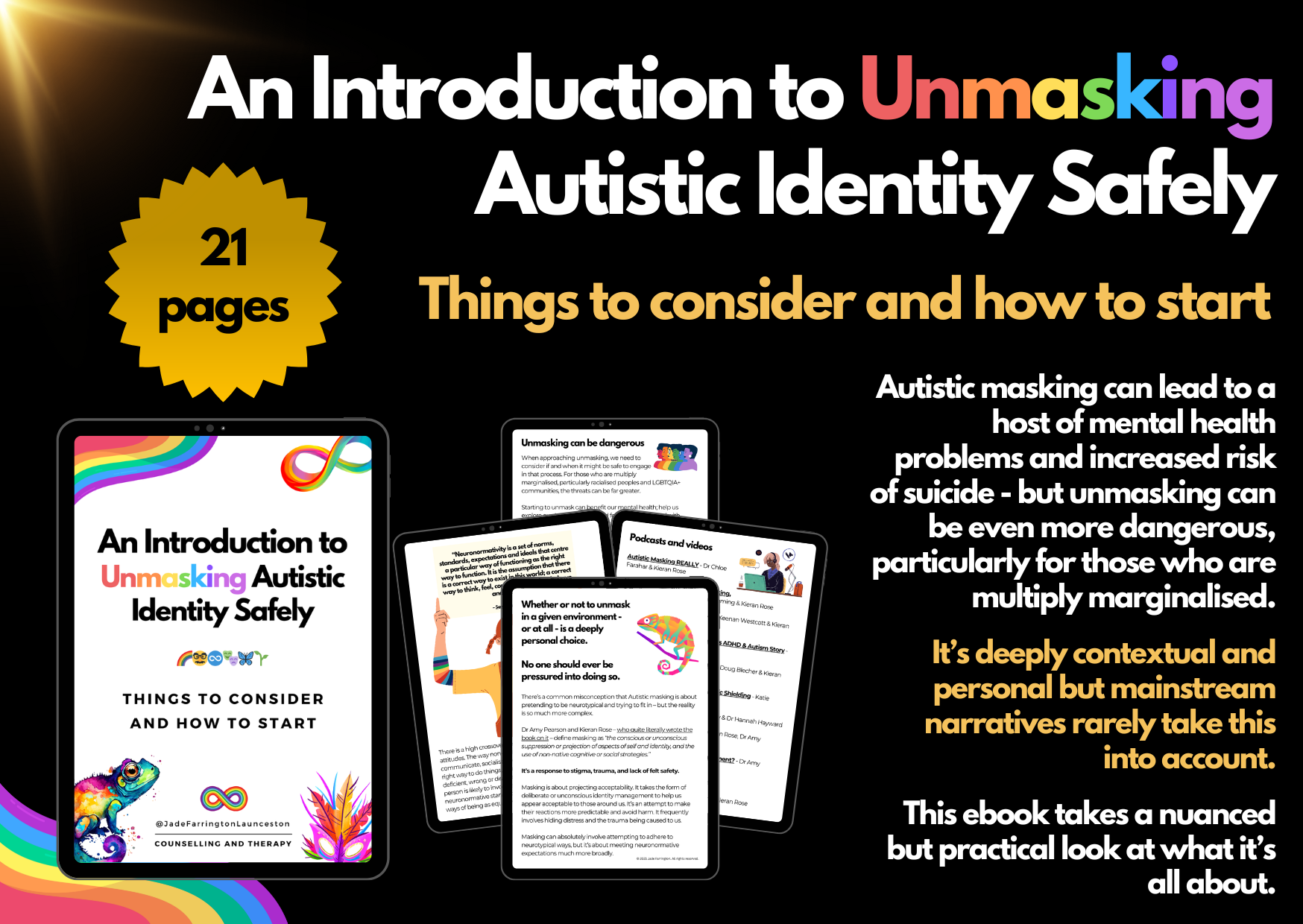
Autistic masking has been shown to lead to a host of mental health problems and increased risk of suicide – but unmasking can be even more dangerous, particularly for those who are multiply marginalised. It’s deeply contextual and personal but many of the mainstream narratives don’t take this into account.
There’s a common misconception that Autistic masking is about pretending to be neurotypical and trying to fit in – but the reality is so much more complex.
This new 21-page resource digs a little deeper. It offers:
♾️ An introduction to a broader understanding of Autistic masking and signposting to in-depth discussions for those who would like to dive down the rabbit hole.
♾️ A discussion of why we may or may not want to unmask in different contexts – and why it may not be safe to do so.
♾️ Practical steps you can take to explore and understand what masking means for you.
You can download this ebook and all my other resources by upgrading to a paid Substack subscription, or purchase them individually here.
Children
Mick Olds considers whether ‘safety’ is being used as a reason to justify unnecessary breaches of bodily autonomy
Paul Stevenson has released ‘My Tics and Me’, a picture book introducing young children to Tourette Syndrome
Yellow Ladybugs responds to Australia’s cuts to services for Autistic children
Viv Dawes on how parents of neurodivergent children stop trusting anyone after being beaten up by the system
Em Hammond says different kids need different things, and it’s important to know what they are
Helen Edgar is curating a list of neuroaffirming courses for parents and carers to support Autistic young people
Helen Daniel outlines gentle parenting for Autistic children
Elspeth Hetrick explains why Autistic and ADHD kids don’t need to comply with societal standards
Em Hammond has created a printable poster to help children remember their body’s messages
Autism Goggles asks people not to tell the world how hard it is to care for those who are struggling
Tania Wieclaw explains why fear-based compliance doesn’t teach regulation
Sandhya Menon has published ‘My Body’s Power Pack: How to Manage your Energy and Stay in Charge!’ to help children understand why their energy ebbs and flows
Liz Evans and Rebecca Rae-Hodgson discuss parenting with chronic illness
Teo Byrne explores bath time as a multi-sensory experience
Jane McFadden explains the harm done to children when they are talked about like problems to solve
Dmitry Ciocea on letting children reach developmental milestones on their own timeline
Victoria Navin has created a sensory-rich and inclusive UK teaching calendar
Emily Price shows some Autistic play styles
Helen Buzdugan explains why upcoming UK reforms are likely to remove support from many disabled children
Teo Byrne responds to Policy Exchange’s report as a “political and moral car crash”
PDA
Kristy Forbes lets parents, carers and PDAers know they’re doing their best
Danielle Jata-Hall on the violence of ableism directed at disabled children
Sally Cat shares what they do when they want to get things done
Lyndsay Critchlow has published ‘PDA My Way’ about how PDA affects her
Caitlin Hughes on understanding PDA through Internal Family Systems
Listening to PDA young people discuss school disconnection
Laura Hellfeld has created on-demand courses for teachers, healthcare professionals and others working with PDAers: Course 1: Understanding PDA: Foundations for Neuroscience-affirming Support | Course 2: PDAers in Distress: Reframing Challenging Behaviour & What We Can Do Now
Education
Destiny Huff shares some neuroaffirming accommodations that can be implemented in schools
Dr Joanne Riordan has created a free webinar on ‘The Neuro-Affirming Return to School’
Bri Guerra on painful memories of melting down at school
Caro Giles has released ‘Unschooled: The Story of a Family That Doesn’t Fit In’
AJ’s Brain shares university tips for neurodivergent students
Dr Jaime Hoerricks offers a transition guide for the class of 2026 and the reality of the world they’ll be stepping into.
Kaishawna on how the term ‘adaptive education’ can centre disabled learners
Ava shares her experience of before and after exam results day
Heidi Mavir encourages families to check their school’s policy on seclusion and restraint due to neurodivergent children being restrained by adults
Sammi Patterson on the damage done to their son by being placed in isolation
Destiny Huff explains how Positive Behavioural Interventions and Supports can miss the mark for neurodivergent learners
Joyner Emerick on the erasure of disability and the weaponisation of special education against Black students
‘It Takes All Kinds of Minds: Fostering Neurodivergent Thriving at School’ is now available to pre-order
Amanda McGuinness has produced school autism communication passports
Shubha Balabaer on unschooling and social skills
Helen Edgar outlines how teachers can build connections with pupils with profound and multiple learning disabilities
Michaela Silsby explains why forcing school attendance is not ok
Marie Hutchinson-Ralph on the systemic abuse of young people in the UK education system
Marion McLaughlin looks at the damaging obsession with school attendance
Dr Joanna Grace has put together a playlist for people starting work teaching those with profound and multiple learning disabilities
Apraxia and Non-speakers
Shubha Balabaer discusses how to prepare for police and military in their cities with non-speaking kids
Mick Olds on Bluey, AAC, play, connection and joy
Teo Byrne explains how she supports her non-speaking son when he has meltdowns in public
Joyner Emerick shares how their son communicates with YouTube clips
Kaishawna shares their experience of using AAC in an interview
Tiffany Hammond explains why compliance isn’t something her family gets to ignore
Speech and language therapist Ruth Jones has released an AAC journal for planning for communication success
TJ shares how non-speakers may find it easier to speak in different languages
Tiffany Hammond explains how her son started communicating through AAC despite professionals saying he was too “severe”
Dmitry Ciocea on listening to non-speakers above those who dehumanise them
Swarit Gopalan explains how he adapts his routines when his body is having a hard time
Tiffany Hammond shares her son’s communication journey
The family of an apraxic teenager accepted into MIT have shared his story after he was previously misdiagnosed with an intellectual disability because he couldn’t use mouth words
Meghan Ashburn on the dangers of segregating non-speaking students
Use of Language and Pathologisation
John Watts reflects on how Simon Baron-Cohen shaped the way the world sees autism and why that’s a problem
Tiffany Hammond responds to the idea that “autism has been hijacked by narcissists”
Ayanna Sanaa Davis on the reality of being a Black Autistic woman
Dr Chloe Farahar looks at how Autistic masking got its name
David Gray-Hammond acts out the application of functioning labels to allistic people
International Coalition Against Restraint And Seclusion highlights how the phrase ‘challenging behaviour’ was invented, and the decades of harm it’s caused
Evaleen Whelton discusses scrapping the medical model of autism
Viv Dawes on the tight grip of the medical model
Dean Beadle explains why he’s Autistic, not a person with autism
Courtney Ahn asks people to stop using ‘non-speaking’ or ‘non-verbal’ to describe verbal shutdowns
Sher Griffin on mind colonisation and the systematic overwriting of Autistic realities with neuronormative assumptions
Gary Hawkins outlines how Autistics and ADHDers are often misdiagnosed with personality disorders in the UK
Jocelyn and Kaligirwa explain why Asperger’s is no longer a diagnosis
Charlie Hart asks cisgender men to stop creating content about ‘female autism’ and ‘ADHD women’
Viv Dawes explains why there is no such thing as ‘symptoms’ of autism or ADHD
Diversity Doodles on the never-ending list of reasons why someone “can’t be Autistic”
David Gray-Hammond on why he doesn’t think ‘ASD level 1’ is a good description for him
Courtney Ahn on what it would be like if Autistics talked about neurotypicals in the same way
Dr Noc looks at the people behind RFK Jr’s autism research
Sonny Jane Wise has produced an infographic to explain what neurodivergent is and is not
Ayanna Sanaa Davis explains why white Autistic people often have advantages over Black Autistic people
Dr Joanna Grace on the intersection of autism and profound & multiple learning disabilities
Kelly Banks explores the damage caused by the term ‘high functioning’
Neurodiversity Paradigm Exploration
David Gray-Hammond offers a metaphysical inquiry into neurodivergence
Helen Edgar on difference, becoming, and the politics of refusal
Teo Byrne outlines why challenging neuronormativity is the foundation of equity, safety and justice
Karenza Harding outlines Mad Pride
Jami L Anderson and Simon Cushing have released ‘Contemporary Philosophy of Autism’
David Gray-Hammond on the true nature of neurodiversity
David Gray-Hammond looks at what makes neurodivergent people neurodivergent
I outline my and Teo Byrne’s path through the neurodiversity paradigm
Late Identification
Suzi Payton shares the response when she realised she was Autistic
Jennifer Berney explains what’s changed in social situations since learning she’s AuDHD
Seán Ronayne on cataloguing birdsong and being diagnosed Autistic
A review finds that around 90% of middle-aged and older Autistic adults in the UK are undiagnosed
Allan White on primitive technology and realising he is Dyspraxic
Molly Siobhan Parker shares how her late diagnosis inspired a comedy screenplay
Neurodivergent Cultures and Ways of Being
Kieran Rose on reclaiming Autistic food identity
Naureen Hunani considers Autistic feeding differences, misconceptions, and the path to joy
Helen Edgar outlines SPACE-TIME – a monotropism informed framework for Autistic people
Eileen Workman looks at ‘literalism’ and meta-messaging in communication
Bri Guerra shares the feeling of the flow of joy as intense energy
Fergus Murray and Haje Kamps discuss autism and monotropism
Helen Edgar explains polytropism vs monotropism, and how Autistics, ADHDers and AuDHDers are more likely be monotropic
Kyrus Keenan Westcott and Kieran Rose discuss Autistic and ADHD experience and masking
Kieran Rose and John Fleming discuss stigma, masking and rediscovering identity
Lou Chandler shares Autistic traits she assumed she didn’t experience, and how she actually did
Anissa Ljanta explains the hidden purpose of limerence
Sher Griffin unpicks selfishness vs self-centering
Teo Byrne shares how she experiences being Autistic and ADHD as a synchronous symbiotic relationship, not a clash
Dean Beadle explains why Autistic Pride is an act of defiance
Sarah Kurchak looks at what happens when Autistic special interests get cancelled
Marion McLaughlin asks what it means to be Autistic
Mandy Cook explains why Autistic people may struggle with broad, open-ended questions
Dr Roger Jou has uploaded the recordings of numerous CASY webinars about autism and neurodiversity
Niamh Garvey has released ‘The Autistic Guide to Communicating and Connecting: Understanding our communication differences and social needs’
Aileen Paterson introduces The Autistic Library and why it was created
Ayanna Sanaa Davis on art as a form of resistance
Maxfield Sparrow outlines autism as a developmental disability, not a developmental delay
Hanna Keiner on thinking in spirals and constellations
Hanna Keiner outlines how rhizomatic thinking helps us make sense of why small choices can feel so big
Teo Byrne looks at bluntness as relational clarity and how to not take it personally
Kelly Banks explains why ADHDers don’t feel accomplished after accomplishing things
Mati Boulakia-Bortnick shares the Autistic experience of being stuck and why it’s nothing like laziness
Wellbeing and Neurodivergence
Julia Lee Barclay-Morton begins exploring the intersection of autism, long covid and disability
Courtney Ahn on the privilege of being able to ignore “difficult” topics that other community members are dying from
Tiffany Hammond outlines why there are no ‘better ways than ABA’ for Black Americans trying to survive whiteness
Teo Byrne shares an anti-performance manifesto and rails against resilience as a demand
Dr Glenn Patrick Doyle offers practical advice for those stuck in traumatic environments
Catherine Luna Blyth explains why pushing yourself out of your comfort zone may be a step too far
Mick Olds shares the sensory weight of disability
Oswin Latimer on Autistic catatonia and watching The Ride Ahead
Monique Lindner on discerning between “I don’t feel like doing that thing” or “my body doesn’t have the capacity for that thing”
Rich Howell on the nightmare of wristbands and events staff who won’t listen
Autism and Psychedelics: A Continuing Conversation with Nick Walker and Daan Keiman is available to watch on demand
Natasha Leahy looks at why Autistic honesty gets shamed
Kate Boot says Autistic distress is not inevitable
Teo Byrne looks at understanding movement from a neurodivergent perspective
Bridgette Hamstead on ageing, autism, and the quiet terror we don’t talk about
Bridgette Hamstead on the reality of ageing, autism, long term elder care, and what we might do about it
Dean Beadle outlines how neurodivergent people live with the pressure and shame of ‘should’
Theresa Scovil looks at how internalised ableism can get in the way of making accommodations
Courtney Ahn reminds adults they can do whatever they want to do
Kelly Mahler looks at how compliance silences the body and wellness
Lou Chalmers outlines her experience of the distress caused by subtle negative social interactions
Kara Ketter on why stimming is a solution, not a problem
Tanya Adkin explains lilipadding through Autistic burnout with a practical guide to rehabilitation
Alice Running outlines how her Autistic family manages transitions and loss
Sophie Willow shares their experience of PMDD and burnout
Janae Elisabeth on burnout treading and trying to keep your head above water
Kay Louise Aldred on defining and understanding boundaries
Sonny Jane Wise explains why aggressive meltdowns don’t make them a bad person
Brett Whitmarsh shares how coming out was the start of unmasking as Autistic & ADHD
Lovette Jallow explains why treating people how you want to be treated can hurt relationships
Lindsay Douglas on what it’s like when even special interests feel like obligations
Charlie Hart shares what she would like people to know about acquired neurodivergence and CPTSD
Kristen McClure outlines the SOOTHE protocol for moving through rejection sensitivity episodes
Dr Talia shares five lessons that help them relate to unpleasant symptoms
Lovette Jallow looks at why small talk exhausts Autistic and ADHD people
Neurodivergent-Affirming Practice
Ayanna Sanaa Davis explains why amplifying the voices of Black Autistic women is essential
Meg Ferrell outlines how neurodiversity-affirming care is about dismantling the systems that harm us
Helen Edgar explains why neurodiversity-affirming practice matters and neurodiversity-lite is harmful
Dr Joanna Grace looks at how to work out who to listen to
David Gray-Hammond reflects on learning from the Autistic Mental Health Conference 2025
Helen Edgar shares ideas for neurodivergence competency
Hannah Cheriford on the Autistic search for a therapist who’s a good fit
Open Future Learning on the harm of treating those with intellectual and developmental disabilities as angels
Melanie Heyworth outlines what traditional social skills courses get wrong and what an affirming non-Autistic social skills course would look like
Jude Carn explains why therapist identity matters
Dmitry Ciocea explains the meaning of presuming competence
Philippa Balazs asks if Autistic clients are best served by Autistic therapists
Scott Neilson explores how to build safe environments for Autistic and otherwise neurodivergent people
Lovette Jallow looks at why CBT fails so many Autistic people
Kristen McClure on why neurocultural competence matters
Teo Byrne asks if people are really “refusing help” – or if help isn’t accessible?
David Gray-Hammond reviews positives and negatives of being under a mental health crisis team
Hanna Keiner on neuroqueering coaching
Work and Employment
Jess Thom shares the impact of the government’s cuts to the Access to Work scheme
Katie Munday on embracing authenticity in academic presentations
Dr Chloe Farahar shares their journey from “not capable” to leading change with a new role in NHS transformation
Erika Sanborne outlines their morning routine
Annie Crowe outlines neuroneutrality as a way to speak about neurodivergent traits at work
Kelly Tuttle on journaling at work and supporting brain healing and personal growth after injury
Teo Byrne looks at how to support neurodivergent drivers in transport and logistics
Kristen McClure looks at the window of tolerance at work
Autistic Ang looks at how boredom can point you to better work
Justine Field on establishing workplace adjustments and learning to advocate for your Autistic needs
Molly Anderton shares her experience of holding boundaries in lived experience roles
Shadia Hancock looks at how to support meaningful work opportunities
Neurodivergent Health
Marion McLaughlin shares their experience of being Autistic and post menopausal
Autism Level UP! and All Brains Belong VT have produced a resource to help people regulate energy when they don’t have any
Alison Escalante on why patients benefit from seeing an Autistic doctor
vōx on how illness taught them hope, compassion and presence
Dr Talia shares mixed messages to look out for related to chronic illness and pain
Janae Elisabeth looks at how vaccine injury creates and perpetuates the myth that vaccines cause autism
vōx shares how they crawl out of a black hole during a flare up
Jesse Meadows has created a history of POTS
Julia Lee Barclay-Morton describes 5.5 years of long COVID
Research
Dr Jaime Hoerricks on the impact of research that seeks to erase our existence
Dr Angela Kingdon looks at whether self-identification is valid
Ann Memmott explores August’s autism, ADHD, dyslexia and dyspraxia research
Anne Borden King asks how we got to the point where Autistic children are being harmed in bogus clinical trials
Anne Borden King on autism researchers and the proxy consent loophole
Chris Papadopoulos explores the use of AI chatbots for Autistic people
A global survey of people with hypermobile Ehlers-Danlos syndrome (hEDS) and hypermobility spectrum disorders (HSD) demonstrates how widespread pain is
Sarah Parkin discusses research showing how AI tools used by councils are downplaying women’s health needs
Kristen McClure gives an August ADHD research update
Jane McFadden challenges the idea that ADHD meds ruin kids’ health
Autistic SPACE for inclusive education
Amanda Hind is recruiting participants for her PhD study exploring the school experiences of Black and Black mixed heritage Autistic women and girls in the UK
Dr Jamie Hoerricks critiques a study suggesting workplace chemicals “worsen autism”
Dr Jaime Hoerricks looks at the global consequences of China’s autism research
Jesse Meadows rounds up research into post-viral illness history, how medical gaslighting happens, and Autistic joy
Alice Running looks at fact vs panic in academic fabricated and induced illness analysis
Reflections of an Autistic researcher studying autism
Kristen McClure sums up research into ADHD, women and hormones
 Jade Farrington - Neurodivergent Counsellor and Rewind Trauma Therapist
Leave a comment